
The market in which we operate
The JSE-listed property sector in South Africa continues to grow, with 37 companies managing assets of over R572 billion (2015: 27 and R350 billion, respectively). Following the influx of capital after the introduction of REIT legislation in 2013, the local sector is ranked among the top 10 REIT markets globally.
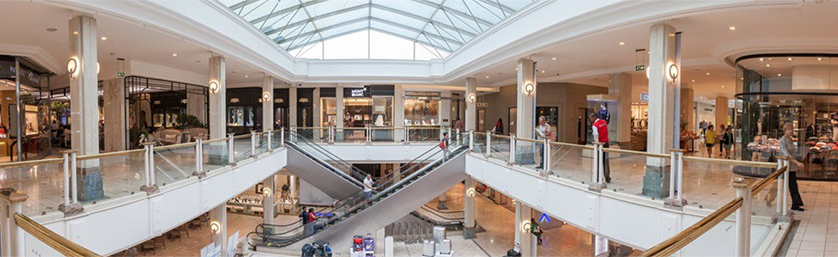 Hyde Park Corner, Johannesburg, Gauteng
South Africa’s listed property sector has produced an annualised return of 17,5% over the past 10 years, well above the return from other equities. Total returns for the 12 months to June 2016 continued that trend with only bonds (11,2%) outperforming listed property (9,6%). Hyprop’s total return for FY16 was 12,5%.
Despite a challenging macro-economic backdrop, the threat of a sovereign credit downgrade, political uncertainty, rand depreciation and rising interest rates, South African listed property funds like-for-like growth in net property income was 5,7%. Hyprop’s like-for-like net property income growth for FY16 (from the South African portfolio) was 7,3%.
Property is a long-term asset class. However, the investor community generally has a short-term focus, which puts pressure on REITs to produce short-term dividend growth. To better balance these short-term needs with long-term sustainability, many SA REITs have increased their exposure to overseas assets, with some 48% of total assets now based offshore due to limited domestic opportunities and relatively low European funding rates.
The outcome of the UK referendum on European Union membership (commonly referred to as Brexit) had a material impact on property indices in the immediate aftermath, but volatility in the South African index has since subsided. Analysts believe South-Eastern Europe, where local funds (including Hyprop) are most exposed, will experience only a limited economic impact as these countries have few direct links to the UK and the associated risks are offset by recent fiscal improvements.
South Africa
South Africa is recording high population growth and urbanisation, with a growing middle class stimulating demand for retail space. The country now has over 2 000 shopping centres, spanning more than 23 million square metres of retail space. While global peer comparisons suggest that South Africa has more retail space than demand dictates, data proves that shopping centres offering a broader tenant mix (including national and international retailers, entertainment and catering/leisure) are attracting growing numbers of consumers.
South Africa’s economic growth slowed further in 2016. From 2,2% in 2013 to 1,3% in 2015, the South African Reserve Bank’s mid-year projection pegs GDP growth in 2016 at 0%, rising to 1,1% and 1,5% over the next two years.
Consumer spending is under pressure due to rising interest rates and inflation, reflected in slowing retail sales growth.
Sub-Saharan Africa
In contrast, Africa’s economic growth was firm for the first half of the review period, with growth in real GDP of 3,6% entrenching it as the world’s second-fastest growing economy (after East Asia). The relatively high economic growth rate of over 3% in West Africa, where Hyprop is invested in four shopping centres, is encouraging. However, global factors, chiefly low commodity prices and exchange rate volatility, will have an impact and we are monitoring conditions closely.
Generally, operating conditions in sub-Saharan Africa reflect weaker economies amid softer oil and commodity prices, local currency depreciation and country-specific issues. Although asset valuations and debt funding are both denominated in USD, tenant revenues are earned in local currency. This places local tenants under pressure at a time when consumers are battling with the impact of high inflation on disposable income. However, key cities where Hyprop is invested like Lagos, Accra, and Lusaka have recorded sustained economic growth, with further urbanisation, population growth and industrialisation.
South-Eastern Europe
There has recently been a marked increase in investment activity, particularly in the retail sector, in core central and eastern European markets.
Hyprop entered Europe in 2016 by acquiring majority stakes in leading malls in Serbia and Montenegro. Both countries are recording solid economic growth, underpinned respectively by improving domestic demand and strong foreign direct investment inflows.
Sources:
Supporting data for this market overview has been drawn from analysts’ reports, StatsSA, South African Reserve Bank and others.